
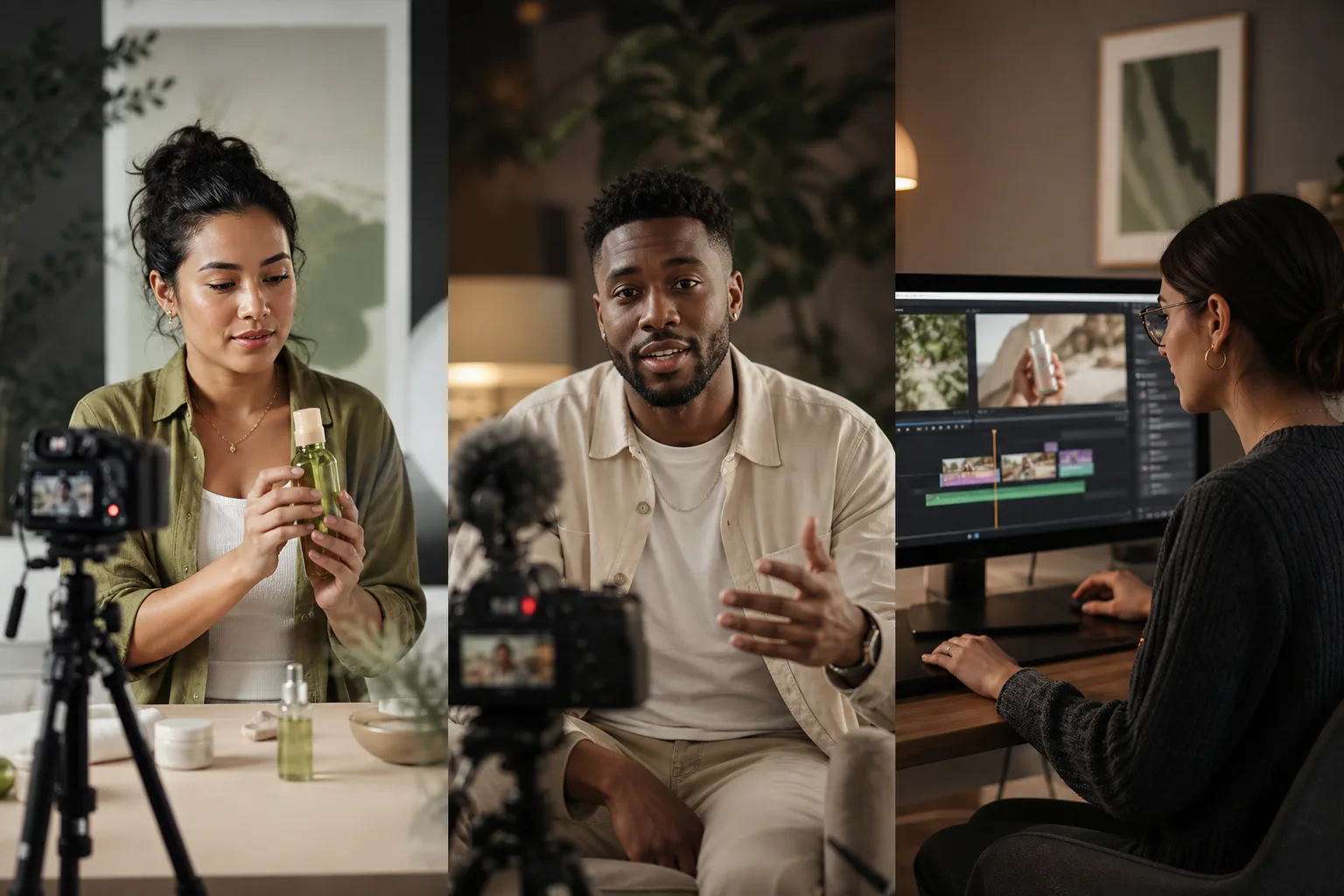
These terms blur together in many briefs. One creates a fresh creator story, one uses a creator's identity and audience, and one turns an approved archive into new short-form narratives.
Decision map
UGC's core asset is a new creator story; influencer marketing's is the creator and audience relationship; clipping's is approved source material adapted for distribution.
Choose through the objective, source, rights, and publication plan—not follower count alone.
One campaign can combine all three, but rights, reward logic, and evidence should stay explicit for each delivery.
The three-box test
Put three boxes on the table. The first contains the product and a new creator recording: UGC. The second contains the creator's identity, trust, and existing audience: influencer marketing. The third contains an approved podcast, webinar, demo, or event archive: clipping.
If the campaign cannot identify the missing box, the format conversation has started too early. Ask whether you need a new story, existing distribution, or new short-form value from the archive.
Compare the models on the same dimensions
UGC and clipping can be production methods; influencer marketing often includes a distribution relationship. ‘Which is better?’ is therefore incomplete. Compare the decision dimensions instead.
| Dimension | UGC | Influencer marketing | Clipping |
|---|---|---|---|
| Raw material | New creator recording | Creator voice and audience | Approved existing source |
| Core value | Fresh human story | Identity-led distribution and trust | Many short stories from an archive |
| Publication | Brand or creator account, rights dependent | Usually creator account | Creator or brand account, brief dependent |
| Main risk | Scripted ad feel | Concentration in one creator | Minimal-change reupload and unclear rights |
| Good fit | Experience and demonstration | Community and identity fit | Podcast, event, education, and demo archives |
When UGC leads
UGC is useful when the job is demonstrating product use, answering an objection, or showing different customer contexts. A large audience is not required when production is the asset.
Its common failure is an overcontrolled script. When every creator says the same line in the same order, the brand gets more files but little creative learning.
When influencer marketing leads
Influencer marketing fits when a trusted identity, specific community, or long-term creator relationship is central. The brand is buying more than a video file; it is entering the creator's publishing context.
The risk is making one person carry the whole campaign thesis. Audience size does not guarantee product fit. Usage rights, publication period, disclosure, measurement access, and reuse need to be explicit.
When clipping leads
Clipping is useful when the brand already owns strong conversations, education, events, or demos that disappear in long-form. Different creators can rebuild the same source through distinct hooks, edits, and commentary.
That advantage disappears when rights are unclear or the creator simply cuts and reposts. YouTube's reused-content policy is a useful reminder that permission and meaningful transformation are different questions.
A hybrid campaign
Imagine a fitness app launching a new training program. Two specialist creators film their own UGC experience. A fitness influencer tests it with their community. Expert webinar answers become permission-led clips.
The work shares one campaign but not one review rule. UGC is reviewed for proof and brief fit, influencer work for agreement scope, and clipping for source rights and editorial transformation. Any performance reward needs a cap and review rule in advance.
Selection checklist
Answer these five questions before choosing the format. If more than one box is needed, build a hybrid while keeping ownership and evidence separate.
- Do we need a new product experience, an existing audience, or a source archive?
- Who publishes, and for how long does the content stay live?
- How do we separate production work from distribution performance?
- Which claims are supported and which are prohibited?
- Which signal will actually help the next campaign decision?
Common questions
Does a UGC creator need a large following?
No. UGC's core value is production and storytelling. Audience fit becomes a separate question when the creator also publishes.
Is clipping influencer marketing?
They can overlap when a creator publishes approved clips to their audience, but clipping starts as a production and retelling method.
Can the brand reuse the video in ads?
Only if the agreement and usage rights allow it. Organic publication permission does not automatically include paid or perpetual reuse.
Sources and editorial notes
- YouTube channel monetization policies — YouTube Help. YouTube's current distinction between reused content, meaningful transformation, and copyright enforcement.Last checked:
- Create YouTube Shorts with remixed content — YouTube Help. Official remix tools, attribution behavior, permissions, and what happens when a source is restricted or removed.Last checked:
- Promoting a brand, product, or service on TikTok — TikTok Support. TikTok's current requirement to use its content disclosure setting for promotional or branded content.Last checked:
This article was prepared by the MuchCreator editorial team using product documentation and the linked primary sources. Platform rules can change, so check the current policy pages before publishing.
Editorial and corrections policy